Proof of Sats
White Paper
Bitcoin numismatics, cryptographic art
& physical sovereignty.
Introduction
The value of Proof of Sats
Bitcoin introduced a new concept: digital scarcity.
Rare sats are the most granular expression of that scarcity. Fragments of bitcoin endowed with exceptional properties - tied to the major periodic events of Bitcoin mining, to founding moments in Bitcoin's history, or to unique numerical characteristics - they constitute a new form of numismatics, entirely native to the protocol. The market has recognised them as such: institutions like Sotheby's have held dedicated sales, certain sats trade for several million dollars, and several dedicated marketplaces have emerged.
Yet owning a rare sat remains, today, a deeply technical experience. Wallets, UTXOs, Taproot addresses, Ordinals indexers... The complexity of the digital custody chain creates a real barrier, one that denies most collectors direct access to these assets.
Proof of Sats was born to remove that barrier.
We believe that the scarcity inscribed in the Bitcoin protocol deserves to exist in the physical world, in a form as rigorous as it is beautiful. Each Proof of Sats card is a self-contained vault that encapsulates a rare sat - with its private key, its complete on-chain data, and a mathematically unique generative artwork - inside a premium physical collectible, verifiable without any intermediary.
This white paper documents the foundations of the project: the nature of rare sats, the anatomy of the card, the artwork generation process, the manufacturing and security chain, and the project roadmap. It is addressed to rare sat collectors and to those who wish to discover them alike.
Understanding
What is a rare sat?
A rare sat is a fragment of bitcoin that combines certain rarity characteristics. Sat is short for satoshi, the smallest divisible unit of a bitcoin, named in homage to Satoshi Nakamoto, the anonymous creator of Bitcoin.
The DNA of Bitcoin: from grain of sand to gold nugget
One bitcoin contains 100 million satoshis. With an absolute cap of 21 million bitcoins, the total supply of sats is exactly 2.1 quadrillion units. Each sat was created in a specific block, at a specific moment in history, and is permanently inscribed on the Bitcoin blockchain.
Thanks to the Ordinals protocol, every satoshi can now be assigned a serial number based on its order of creation. This number makes each sat individually traceable across the blockchain.
This is where the magic happens. Each satoshi becomes non-fungible. While their face value remains identical on the financial market, their collectible value diverges radically. Like coins in traditional numismatics, certain sats become extraordinarily rare and valuable.
At Proof of Sats, we decided to bring these digital collectible assets into the physical world, by embedding them in vault-grade collection cards that securely hold these rare sats — a way to evangelise rare sats, lower the technical barriers to on-chain ownership, and turn them into beautiful physical collectibles accessible to all.
From code to collectible.
Proof of SatsBitcoin numismatics
Two major families of rare sats have emerged within the collector community.
Protocol milestones
Sats tied to the periodic mining events of the Bitcoin network (first satoshi of a block, following a halving, epoch openings…) as defined by the Rodarmor nomenclature.
Extraordinary satoshis
Sats linked to key moments in Bitcoin's history (first transaction, Block 9, mined by Nakamoto) or endowed with special numerical properties (palindromes, 2- or 3-digit sequences).
A prestige market already very real
This is not a speculative concept — the rare sats market is active, liquid, and attracting institutional attention.
Sotheby's · 2024
The world's largest auction house held several dedicated Rare Sats sales, recognising them as fully-fledged collectible assets.
View the sale →Epic sat · 33.3 BTC
The "Epic Sat" from the block marking the last halving (block 940,000) sold at auction for 33.3 BTC — over $2.1 million at the time.
Read the article →Proof of Sats
The Proof of Sats card
Proof of Sats offers a collection card as a physical medium for the secure storage of rare sats. Each card is a self-contained vault — it holds a rare satoshi and all its identification data, along with the corresponding private key sealed beneath a tamper-evident security label. The complete cryptographic identity of the sat is encoded in a generative artwork. The whole is preserved inside a transparent plastic case sealed by UV polymerisation.
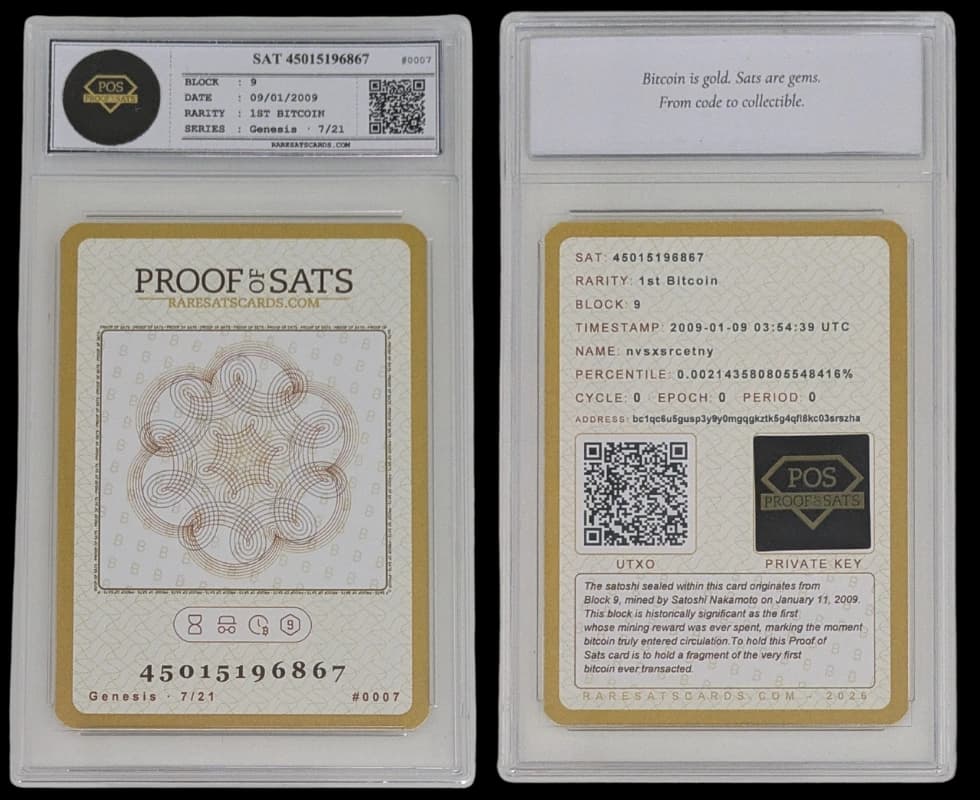
CARD ANATOMY
↡ Physical sovereignty
Holding a Proof of Sats card with its seal intact means holding exclusive custody of the private key, and therefore of the satoshi embedded within it. It means holding, sovereignly and in cold storage, a digital asset in the form of a physical collectible object.
03 — Cryptographic art
The artwork: beauty encoded in mathematics
At Proof of Sats, we believe that the beauty of Bitcoin lies in its mathematics. So that each card is as unique as the satoshi it contains, we have developed a generative design process rooted in cryptography.
What is the SHA-256 algorithm?
SHA-256 (Secure Hash Algorithm, 256 bits) is the engine of Bitcoin. It secures the network and links each block to the next. Its fundamental property: change even a single digit in the input, and the output is completely different and totally unpredictable. It is a one-way mathematical fingerprint.
Take two consecutive sats separated by a single integer: their cryptographic fingerprints share absolutely nothing in common. Each artwork is therefore mathematically unpredictable from the sat number, and completely irreproducible from any other sat.
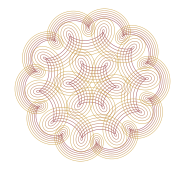
From serial number to Guilloche
For each card, we use the satoshi's unique number as input data. Our software then transforms the cryptographic hash of that number into a complex geometric figure inspired by Guilloche patterns.
The Guilloche tradition
Traditionally used on banknotes and certificates of authenticity, the Guilloche is a complex interlaced pattern generated by mechanical rose engines. Virtually impossible to reproduce by hand, it has protected currency for centuries — and we found it perfectly suited to rare sats.
Mathematical signature
The Proof of Sats artwork is not a random drawing. It is the direct visual translation of the satoshi's mathematical identity — a spirographic rendering of its SHA-256 hash. Band count, radius ratios, rotation angles and colour palette are all derived deterministically.
If you own the card, you own the rare sat and the physical representation of its mathematical fingerprint.
Making of
How a Proof of Sats card is made
Ten steps, an unbroken chain of custody from air-gapped key generation to UV molecular sealing. Every step is designed so that the provenance, security, and authenticity of each card are unconditionally verifiable.
Cold key generation
Taproot addresses and private keys are generated on an air-gapped workstation (Tails OS, no Wi-Fi or Bluetooth). A CSV holds the public addresses; a PDF holds the private keys for secure printing. Private keys are printed via USB — no digital backup retained.
Paper printing of the private key only
WIF keys and QR codes are printed via a locally USB-connected printer. No digital file is retained. The source PDF is securely erased from the air-gapped machine immediately after printing.
On-chain data integration
Each sat is queried in the Ordinals index. Block, timestamp, epoch, cycle, percentile position within the 21M BTC supply and rarity attributes are recorded and added to the production CSV.
Verifiable transfer
Each rare sat is sent to its dedicated Taproot address. The sat's position within the UTXO is then added to the production CSV. It will appear as a verifiable QR code on the back of the card.
Deterministic artwork via SHA-256
The card artwork is generated algorithmically from the sat number. The SHA-256 hash seeds a spirographic rendering engine — band count, radius ratios, rotation angles and colour palette are all derived deterministically. No two sats share the same artwork.
Front & back card creation
A Python rendering engine assembles the complete card layout: artwork, sat metadata, rarity icons, wallet address, UTXO QR code, sat description. Output is a print-ready PDF with crop marks and 3 mm bleed.
Premium printing
Cards are printed using professional machines at high resolution on premium card stock. Cutting follows bleed marks and edges are rounded.
Private key integration
The printed private key is inserted on the back of the card beneath a tamper-evident security label. Once sealed, any attempt to access the key leaves a permanent, irreversible VOID mark.
Label generation
A label is generated for each card (sat number, block, date, rarity level, and edition) in 68 × 20 mm format with a QR code pointing to the card authentication page.
UV molecular bonding — crystal slab
The finished card is permanently encased in a rigid UV-resistant acrylic housing by molecular bonding. The result is a unique, sealed object.
05 — Roadmap
From foundation to prestige market
Proof of Sats is built along a deliberately sequential logic: each phase validates the foundations of the next. Nothing is launched before it is secured. Nothing is communicated before it is produced.
↡ Core principle
Nothing is launched before it is secured. Nothing is communicated before it is produced.
Foundation
Infrastructure, security, creationThe first phase is entirely dedicated to building the project's foundations, without compromise and without rushing.
It encompasses the acquisition of satoshis for the first five series. In order to reach the widest possible audience and anchor our communication on a compelling message, we have chosen sats from the first bitcoin of Block 9 for the first two series.
In parallel, the production and security process is formalised in every detail: each step of the custody chain is designed before the first card is manufactured. The air-gapped hardware — isolated workstation, dedicated printer, USB drives — is acquired and configured. The two proprietary software tools are developed: the deterministic SHA-256 artwork generation engine, and the card production engine. The brand's X account is created and domain names are reserved.
Production
Manufacturing, commercial infrastructure, first communicationsThe second phase marks the project's transition into physical existence: the first cards are produced following the process established in Phase 1, from cold key generation to UV molecular sealing.
The online store launches at raresatscards.com. Communication begins on X, progressively, to build an audience ahead of the Series 1 launch. An early adopter email collection page is set up. This white paper is written and published — the project's first official editorial statement.
Launch
Series 1 — Block 9×450Series 1 goes on sale. One hundred numbered cards, each holding a satoshi from the first bitcoin of Block 9, mined on January 9, 2009 by Satoshi Nakamoto. First drop, first community of holders, first market feedback.
Prestige
Series 2 & Genesis AuctionThe fourth phase introduces two distinct events.
Series 2 launches, following the same production protocol as Series 1, with a rare sat selection defined in advance.
In parallel, the Genesis Series — comprising the first 21 cards ever produced by Proof of Sats — goes to auction. This sale marks the project's entry into the prestige market segment, alongside the major houses specialising in collectible digital assets.
Expansion
Bespoke mandates & new seriesThe fifth phase opens a new dimension of the project: bespoke service.
Proof of Sats will offer, on request, the ability to identify, acquire, and encapsulate specific satoshis on behalf of collectors. A sat tied to a personal date, a founding event, a particular numerical property — found, secured, and preserved inside a unique Proof of Sats card.
New thematic series will also be developed in response to market evolution and acquisition opportunities.
06 — Mission
The ambition of Proof of Sats
Proof of Sats was born from a simple conviction: rare sats are one of the most fascinating forms of digital scarcity ever created — yet owning them remains out of reach for anyone not comfortable with wallets, UTXOs, and the technical complexity of the blockchain. Our ambition is to remove those barriers. Each limited-edition series of cards is an invitation to enter the world of rare sats with no technical prerequisite — just the object, and the certainty of what it contains.
Materialising meaning
But beyond collecting, we believe that certain sats carry an irreplaceable emotional dimension. A block mined on the day of a birth, a wedding, a founding event. The very first Proof of Sats card is a perfect illustration: it holds an Uncommon sat from July 2010, issued just minutes before the birth of the project founder's son.
Research and acquisition
We also wish to offer, on request, the option of embedding personal sats into a card. A sat you already own, or one we help you find and acquire, preserved for decades inside a Proof of Sats collection card.
Rarity within rarity
Each Proof of Sats card carries an absolute serial number, starting at #0000 — directly inspired by the Ordinals inscription numbering system. Whatever the series, whatever the edition, this number identifies each card as the nth ever produced in the project's history. Rarity within rarity.